
What makes saffron so special? Its phytochemical composition.
Saffron is considered red gold in India. Known as a very valuable and expensive spice, it has been used since ancient times for its many benefits.
Its extraction, as shown below, is very meticulous, requiring 150 meticulously handled flowers for 1 gram of saffron.

Saffron’s phytochemical composition
Saffron’s phytochemical composition is found predominantly in the petals and stigma, the latter being the part of the flower that receives the pollen, which is actually the head of the filament in the center of the flower.
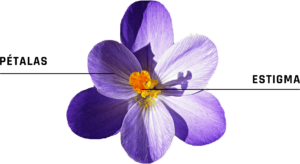
Here is the phytochemical composition of the constituent parts of Saffron that give the product its characteristics; namely the petals
and the stigma of the flower.
Petals: their composition
Flavonoids
Saffron petals are rich in flavonoids, which are substances that have an anti-inflammatory and antioxidant action. Flavonoids also have a number of pharmacological properties
In addition to increasing hair resistance, they are able to react with various types of free radicals that accelerate premature ageing, stabilizing them and thus forming stable compounds on the scalp, slowing down hair ageing.
Tannins

Tannin is a mild natural product that is also found in the petals; it is rich in nourishing properties for the hair. It can even be considered food for the scalp and is responsible for repairing it.
Tannin acts as a natural protein binder and, together with other natural elements, forms a powerful sealing and nutrient-boosting agent, perfect for hair that has been colored or chemically treated.
It concentrates on the hair’s internal strands, filling in the gaps created by the absence of protein, penetrating through the cuticles and acting directly on the macro and microfibers.
Thus, without modifying the hair’s internal structure, it gives shine, softness, elasticity and hydration to the scalp, also promoting greater adhesion and absorption of any treatment to the hair fibre.
Anthocyanins
Anthocyanins are flavonoids that are widely distributed in nature and are responsible for most of the blue, violet and all shades of red that appear in flowers, fruits, some leaves, stems and roots of plants.
The interest in the use of anthocyanins is related to their high antioxidant and anti-inflammatory power, which promotes numerous hair health benefits such as resistance, delaying ageing, fixing color and soothing the scalp.
STIGMA: its composition
Alkaloids

They are some compounds present in the leaves and flowers of plants that give them a very bitter taste, which means “similar to alkalis”, because they have a high pH in solution.
This feature helps to give the scalp a soothing and calming effect.
It is also known for its rubefacient action and is used to promote hair growth and prevent hair loss. Hair is thus born stronger and shinier.
Saponins
Saponins are substances derived from the secondary metabolism of plants, mainly related to their defense system. They are found in tissues that are more vulnerable to fungal, bacterial or predatory insect attack, and are considered part of the plant’s defense system
Saponins thus confer an antibacterial characteristic to hair products. It is also rich in antioxidant and anti-inflammatory properties, promoting numerous benefits for hair and scalp health.


